
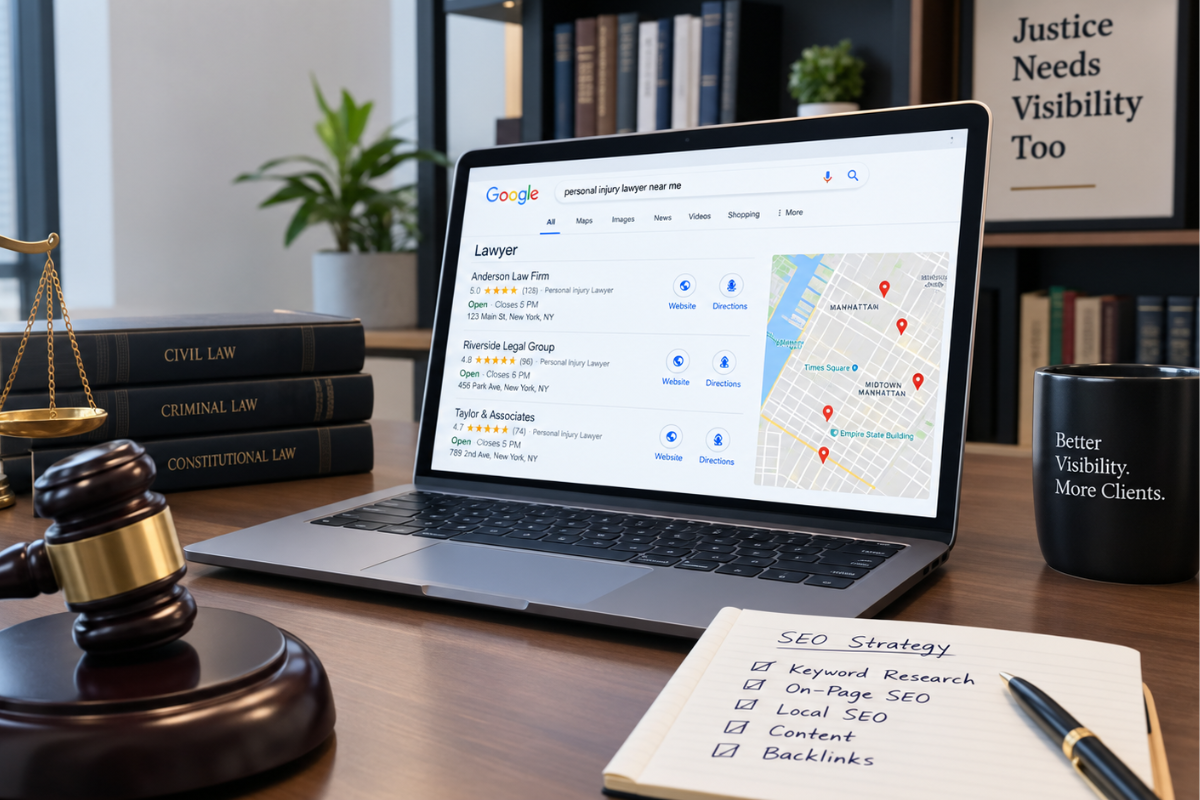
Law firm SEO is the process of optimizing a law firm’s website, content, local presence, and overall online visibility to help it appear in relevant search results and attract potential clients through organic search.
When people need legal help, search engines are often one of the first places they turn. Someone involved in a car accident may search for a personal injury lawyer, a person facing criminal charges may search for a criminal defense attorney, and someone going through a divorce may search for a family lawyer or divorce attorney.
These searches create opportunities for law firms to reach potential clients at the moment they are looking for information, legal services, or representation.
However, ranking a law firm website in organic search is not simply a matter of adding legal keywords to pages. Legal SEO involves a combination of technical SEO, keyword research, content strategy, on-page optimization, local SEO, Google Business Profile optimization, internal linking, authority building, website architecture, reputation management, and conversion optimization.
This complete guide explains how law firm SEO works, what a successful strategy can include, how to structure a legal website, what types of content to create, how local SEO fits into the strategy, common mistakes to avoid, and how to measure SEO performance.
What Is Law Firm SEO?
Law firm SEO is the process of improving a law firm’s website and online presence so that its pages can appear for relevant searches performed by potential clients and people researching legal topics. Professional law firm SEO services can help firms develop and implement a strategy to improve their organic visibility.
SEO stands for Search Engine Optimization.
For a law firm, SEO can involve optimizing the website for searches related to:
- Legal services
- Practice areas
- Lawyers and attorneys
- Legal problems
- Legal questions
- Locations
- Courts and legal processes
- Specific types of cases
- Frequently asked legal questions
For example, a personal injury firm may want to establish visibility for searches such as:
- Personal injury lawyer
- Personal injury attorney
- Car accident lawyer
- Truck accident attorney
- Motorcycle accident lawyer
- Wrongful death attorney
- Personal injury lawyer in [city]
At the same time, the firm may create informational content around searches such as:
- What should I do after a car accident?
- How does a personal injury claim work?
- How long does a personal injury case take?
- What damages can be claimed after an accident?
These searches have different purposes and levels of intent.
A successful SEO strategy considers those differences rather than treating every keyword as the same.
Why Is SEO Important for Law Firms?
Legal services are highly competitive in many markets, and potential clients frequently use search engines to research lawyers, legal services, and legal problems.
A law firm’s website can potentially reach people at several stages of the decision-making process.
For example, someone may begin with:
“What happens after a car accident?”
Later, they might search:
“How much does a car accident lawyer cost?”
Eventually, they may search:
“Car accident lawyer near me.”
These searches represent different stages of the user’s journey.
SEO can help a law firm build visibility across these different stages.
SEO can help law firms:
- Increase organic search visibility
- Reach potential clients researching legal issues
- Generate relevant website traffic
- Build visibility for practice-area searches
- Improve local search presence
- Establish useful legal resources
- Support lead generation
- Build long-term online visibility
- Reduce dependence on a single marketing channel
- Create assets that can continue attracting organic traffic
The objective should not simply be more traffic.
The objective is to attract relevant traffic that can contribute to meaningful business outcomes.
How Does Law Firm SEO Work?
Law firm SEO combines several different areas of search optimization.
A comprehensive strategy can include:
- SEO auditing
- Keyword research
- Search intent analysis
- Website architecture
- Technical SEO
- On-page SEO
- Content strategy
- Practice-area optimization
- Local SEO
- Google Business Profile optimization
- Internal linking
- Link building
- Digital PR
- Reputation management
- Conversion optimization
- Performance measurement
Each component serves a different purpose.
For example, technical SEO helps search engines access and understand a website, while content helps address the questions and needs of users.
Local SEO helps a firm establish visibility in relevant geographic searches, while conversion optimization helps turn website visitors into inquiries.
1. Start With a Law Firm SEO Audit
Before making major SEO changes, it is useful to understand the website’s current condition.
An SEO audit can identify technical, content, structural, local, and authority-related issues.
Technical audit
Review areas such as:
- Crawlability
- Indexability
- XML sitemap
- Robots.txt
- Canonical URLs
- HTTPS
- Redirects
- Broken links
- 404 pages
- Duplicate URLs
- Mobile usability
- Page speed
- Core Web Vitals
- JavaScript-related issues
Content audit
Review:
- Existing service pages
- Practice-area pages
- Location pages
- Blog posts
- Thin content
- Duplicate content
- Outdated content
- Missing topics
- Keyword cannibalization
- Content quality
- Search intent alignment
On-page audit
Check:
- Title tags
- Meta descriptions
- H1 headings
- H2/H3 structure
- URLs
- Keyword targeting
- Internal links
- Image optimization
- Structured data where appropriate
Local SEO audit
Review:
- Google Business Profile
- Business information
- Categories
- Reviews
- Local citations
- Location information
- NAP consistency
- Local landing pages
- Local links
Competitor analysis
A competitor analysis can identify:
- Which practice areas competitors prioritize
- Which topics they cover
- Which pages receive organic visibility
- How their websites are structured
- What types of content they publish
- Which locations they target
- What authoritative websites mention them
The purpose is not to copy competitors.
It is to understand the search landscape and identify opportunities to build a more useful website.
2. Law Firm Keyword Research
Keyword research is one of the foundations of a law firm SEO campaign.
The goal is not to collect thousands of keywords.
The goal is to identify searches that are relevant to the firm’s:
- Services
- Practice areas
- Locations
- Clients
- Business objectives
Types of keywords for law firms
Practice-area keywords
Examples:
- Personal injury lawyer
- Criminal defense lawyer
- Family lawyer
- Immigration lawyer
- Employment lawyer
- Bankruptcy attorney
Service keywords
Examples:
- Car accident attorney
- DUI defense lawyer
- Divorce attorney
- Green card lawyer
- Workers’ compensation attorney
Location keywords
Examples:
- Personal injury lawyer in Miami
- Criminal defense attorney in Dallas
- Family lawyer in Toronto
Informational keywords
Examples:
- What is comparative negligence?
- How does divorce work?
- What happens after a DUI arrest?
- How long does a personal injury claim take?
Long-tail keywords
Long-tail searches are often more specific.
Examples:
- How much does a personal injury lawyer cost?
- What should I do after a hit-and-run accident?
- Can I modify a child custody order?
These searches may have lower search volume than broad keywords, but they can provide useful opportunities because the search intent is more specific.
3. Search Intent Matters
One of the biggest mistakes in SEO is treating every keyword as if it has the same intent.
Consider these searches:
“What is personal injury law?”
This is primarily informational.
“Personal injury lawyer”
This has commercial/service intent.
“Personal injury lawyer near me”
This has strong local intent.
“Best personal injury lawyer questions to ask”
This is more focused on evaluating providers.
Each query may require a different type of page.
Match the page to the intent
For example:
| Search intent | Appropriate page |
|---|---|
| Legal information | Guide/article |
| Practice area | Practice-area page |
| Specific service | Service page |
| Local service | Location/service page |
| Provider research | Service/agency comparison content |
| Frequently asked question | FAQ/supporting content |
The goal is to give the searcher the type of information they are actually looking for.
4. Build a Strong Law Firm Website Architecture
Website architecture is especially important for large law firm websites.
A clear structure helps users navigate the site and helps search engines understand relationships between pages.
A simplified structure could look like:
Homepage
→ Practice Areas
→ Personal Injury
→ Car Accident Lawyer
→ Truck Accident Lawyer
→ Motorcycle Accident Lawyer
→ Wrongful Death Lawyer
Another section could be:
Family Law
→ Divorce Lawyer
→ Child Custody Lawyer
→ Child Support Lawyer
→ Adoption Lawyer
The exact structure should reflect the firm’s actual services.
Do not create pages simply because a keyword exists.
Every important page should serve a legitimate purpose for users.
5. Create Dedicated Practice-Area Pages
Practice-area pages are often among the most important commercial pages on a law firm’s website.
A page targeting a specific practice area should explain:
- What the practice area involves
- What types of cases the firm handles
- How the legal process may work
- What clients can expect
- Relevant legal considerations
- Why someone might need legal assistance
- How to contact the firm
For example, a Car Accident Lawyer page could discuss:
- Types of car accident cases
- Common causes of accidents
- Potential injuries
- Insurance claims
- Evidence
- Liability
- Damages
- Legal representation
- Frequently asked questions
- Consultation information
The page should provide useful information rather than simply repeating the keyword “car accident lawyer.”
6. Technical SEO for Law Firms
Technical SEO ensures that a website can be properly crawled, rendered, understood, and indexed.
Important areas include:
Crawlability
Search engines need to be able to discover important pages.
Check:
- Internal links
- XML sitemap
- Robots.txt
- Navigation
- Orphan pages
Indexability
A page may exist on a website but still not be indexed.
Review:
- Noindex directives
- Canonical tags
- Duplicate URLs
- Indexing errors
- Search engine coverage reports
Website speed
Page performance can affect user experience.
Review:
- Large images
- Unnecessary scripts
- CSS
- JavaScript
- Caching
- Server response time
- Third-party resources
Mobile usability
Many people search for legal services from mobile devices.
The website should therefore be easy to:
- Read
- Navigate
- Scroll
- Call
- Submit forms on
HTTPS
Law firm websites should use HTTPS and maintain a properly configured secure connection.
7. On-Page SEO for Law Firm Websites
On-page SEO focuses on improving individual pages.
Important elements include:
Title tag
The title should accurately describe the page and its primary topic.
Example:
Personal Injury Lawyer in Miami | ABC Law Firm
Meta description
The meta description can summarize what the page offers and encourage relevant users to visit.
Headings
Use logical headings to organize content.
For example:
- Personal Injury Lawyer in Miami
- Personal Injury Cases We Handle
- How Personal Injury Claims Work
- Compensation in Personal Injury Cases
- Why Work With Our Firm?
- Frequently Asked Questions
URL structure
Keep URLs readable and descriptive.
For example:
/personal-injury-lawyer/
is generally clearer than:
/page?id=4728
Internal links
Link relevant pages together naturally.
8. Content Strategy for Law Firms
A law firm’s content strategy should cover both commercial and informational topics.
Commercial pages can target people looking for legal services.
Informational content can address questions that potential clients research before contacting a lawyer.
Examples of informational content
Personal injury
- What to Do After a Car Accident
- How Personal Injury Claims Work
- What Is Comparative Negligence?
- How Long Does a Personal Injury Case Take?
Criminal defense
- What Happens After a DUI Arrest?
- What Is the Difference Between a Felony and Misdemeanor?
- What Happens at an Arraignment?
Family law
- How Does the Divorce Process Work?
- How Is Child Custody Determined?
- Can Child Support Be Modified?
The content should be written for the relevant jurisdiction and reviewed for legal accuracy.
9. Legal Content Requires Accuracy
Legal content is different from many ordinary blog topics.
A law firm’s content can influence how readers understand important legal issues.
Therefore, content should be:
- Accurate
- Clear
- Current
- Jurisdictionally appropriate
- Properly reviewed
- Transparent about limitations
Laws and procedures can vary between jurisdictions and can change over time.
A generic article should not present jurisdiction-specific information as though it applies everywhere.
Where appropriate, explain the relevant jurisdiction and date of the information.
10. Local SEO for Law Firms
Local SEO can be particularly important for law firms that serve specific geographic areas.
Potential clients may search for:
- Lawyer near me
- Personal injury lawyer in [city]
- Divorce attorney in [city]
- Criminal defense lawyer near me
Local SEO helps establish the connection between the firm, its services, and the geographic areas it genuinely serves.
A local SEO strategy may include:
- Google Business Profile
- Local landing pages
- Local citations
- Reviews
- Location information
- Local content
- Relevant local links
- Structured data
11. Google Business Profile for Law Firms
Google Business Profile can play an important role in local search visibility.
A firm’s profile should accurately represent its real-world business.
Important information can include:
- Business name
- Address
- Phone number
- Website
- Business hours
- Primary category
- Relevant services
- Photos
The firm should also monitor and respond appropriately to reviews while respecting professional obligations and client confidentiality.
Avoid manipulating reviews or publishing confidential client information.
12. Location Pages for Law Firms
Location pages can be useful when a law firm genuinely serves multiple geographic areas.
For example:
/locations/los-angeles/
/locations/san-diego/
However, simply creating dozens of pages with the same content and changing the city name is not a strong strategy.
A useful location page should provide meaningful information about:
- The firm’s services in that location
- The geographic area
- Relevant legal services
- Local resources
- Courts or legal processes where appropriate
- How the firm serves clients in the area
Only create location pages that have a genuine purpose.
13. Google Reviews and Reputation
Online reviews can influence how potential clients perceive a law firm.
A firm can develop a legitimate process for requesting reviews from clients, subject to applicable laws, professional rules, and platform policies.
Reviews should never be fabricated.
Law firms should also be careful when responding to reviews because even confirming that someone is a client can potentially create confidentiality concerns.
A response should not reveal confidential information about a person’s case.
14. Internal Linking Strategy
Internal linking is often overlooked.
A well-designed internal linking structure helps users discover related information and helps search engines understand the relationship between pages.
For example:
Law Firm SEO Guide
→ SEO Strategy for Law Firms
→ Law Firm SEO Ranking Factors
→ Law Firm SEO Audit Checklist
→ Local SEO for Law Firms
→ Google Business Profile for Law Firms
Similarly, a law firm’s practice-area content can link to relevant service pages.
For example:
Car Accident Guide
→ Car Accident Lawyer
→ Personal Injury Lawyer
→ Wrongful Death Lawyer
Links should be added where they genuinely help the reader.
15. Law Firm SEO and Link Building
External links can help search engines discover relationships and authority signals across the web.
However, law firms should focus on quality and relevance rather than link quantity.
Potential opportunities include:
- Legal organizations
- Professional associations
- Local organizations
- Industry publications
- Universities
- Community organizations
- Relevant news publications
- Digital PR
- Expert commentary
- Original research
- Useful legal resources
Avoid building a backlink profile based primarily on irrelevant, low-quality, or manipulative links.
16. Digital PR for Law Firm
Digital PR can complement traditional link-building efforts.
A law firm may have opportunities to contribute expert commentary on legal topics or publish original information that journalists and publications may find useful.
Examples could include:
- Legal trend analysis
- Original surveys
- Public legal resources
- Data studies
- Expert commentary
- Educational guides
The key is to create something genuinely useful or newsworthy rather than producing content solely to obtain links.
17. Schema Markup for Law Firms
Structured data can help search engines understand certain information about a website.
Depending on the situation, structured data may be appropriate for:
- Organization information
- Local business information
- Breadcrumbs
- Articles
- FAQs where applicable
Schema should accurately represent the visible content and follow applicable search engine guidelines.
It should not be treated as a shortcut to higher rankings.
18. Law Firm SEO and AI Search
Search behavior is evolving as people increasingly use AI-powered search and answer systems alongside traditional search engines.
Law firms can prepare by creating content that is:
- Clear
- Accurate
- Well structured
- Specific
- Authoritative
- Easy to understand
- Supported by credible information
Use descriptive headings, answer common questions directly, explain legal concepts clearly, and make the firm’s expertise and jurisdictional focus easy to understand.
Traditional SEO fundamentals still matter because AI systems can rely on information available across websites and other sources.
19. Conversion Optimization for Law Firms
Ranking is not the final objective.
A visitor who finds a law firm’s website needs a clear way to take the next step.
Useful conversion elements may include:
- Phone number
- Consultation request
- Contact form
- Appointment option
- Clear calls to action
- Attorney information
- Office information
- Practice-area navigation
Calls to action should be clear without being unnecessarily aggressive.
For example:
Schedule a Consultation
or
Contact Our Personal Injury Team
may be more useful than vague buttons such as:
Submit
20. Mobile SEO for Law Firms
A significant amount of search activity occurs on mobile devices.
A law firm’s mobile website should make it easy for visitors to:
- Read content
- Navigate menus
- Call the firm
- Complete forms
- Find office information
- Access practice areas
Important mobile considerations include:
- Responsive design
- Readable text
- Proper spacing
- Fast loading
- Accessible navigation
- Click-to-call functionality
21. Law Firm SEO vs. PPC
SEO and PPC are different search marketing channels.
SEO
SEO focuses on organic visibility.
Potential advantages include:
- Long-term traffic potential
- Content accumulation
- Organic visibility
- Ability to target informational and commercial searches
However, SEO generally requires ongoing work and does not provide guaranteed rankings or a fixed timeline.
PPC
PPC involves paid advertising.
Potential advantages can include:
- Immediate paid visibility after campaign launch
- Keyword-level targeting
- Geographic targeting
- Budget controls
- Campaign-level measurement
PPC requires ongoing advertising expenditure.
Some firms may use SEO and PPC together rather than treating them as mutually exclusive.
22. How Long Does Law Firm SEO Take?
There is no universal timeline for SEO.
A firm’s results can depend on:
- Website age
- Existing authority
- Competition
- Geographic market
- Practice area
- Existing content
- Technical condition
- Backlink profile
- Content quality
- SEO resources
- Implementation speed
A new law firm website competing in a highly competitive market may face a different situation from an established website with years of relevant content and authority.
Rather than promising a specific ranking within a fixed period, SEO should be evaluated through measurable trends and business outcomes.
23. How Much Does Law Firm SEO Cost?
There is no single standard price for law firm SEO.
Pricing can vary depending on the scope of work.
Factors can include:
- Number of practice areas
- Number of locations
- Website size
- Competition
- Technical SEO requirements
- Content volume
- Local SEO requirements
- Authority-building activities
- Reporting requirements
- Agency or consultant involvement
A small local firm and a large multi-location law firm may require completely different SEO strategies.
Law firms should evaluate what is included in an SEO engagement rather than comparing providers solely on monthly price.
24. Common Law Firm SEO Mistakes
Mistake 1: Targeting only one broad keyword
A website should not depend entirely on one keyword.
A comprehensive strategy can target related services, questions, locations, and topics.
Mistake 2: Keyword stuffing
Repeating phrases unnaturally does not make content better.
Write naturally and cover the topic comprehensively.
Mistake 3: Creating thin location pages
Do not create hundreds of nearly identical city pages simply to capture location keywords.
Mistake 4: Publishing generic AI-generated content without review
AI tools can assist with content workflows, but legal content should be reviewed carefully for accuracy, originality, jurisdictional relevance, and usefulness.
Mistake 5: Ignoring technical SEO
Content cannot compensate for every technical problem.
Mistake 6: Buying low-quality backlinks
Large numbers of irrelevant links are not a substitute for genuine authority.
Mistake 7: Ignoring local SEO
Firms serving local markets should consider their local search presence.
Mistake 8: Publishing outdated legal information
Legal rules and procedures can change.
Review important legal content periodically.
Mistake 9: Focusing only on rankings
Rankings are useful, but they are not the same as qualified leads or clients.
Mistake 10: Forgetting conversions
A website can receive organic traffic without generating meaningful inquiries if visitors cannot easily contact the firm.
25. Law Firm SEO Metrics to Track
SEO performance should be measured using multiple data points.
Organic search metrics
Track:
- Organic clicks
- Organic impressions
- Search queries
- Average position
- Click-through rate
- Indexed pages
Website metrics
Track:
- Organic landing-page traffic
- Engagement
- Conversion rate
- Contact-form submissions
- Phone calls
- Consultation requests
Local metrics
Where applicable, monitor:
- Local search visibility
- Google Business Profile interactions
- Calls
- Website visits
- Direction requests
Business metrics
Ultimately, law firms should connect marketing performance with:
- Qualified inquiries
- Consultations
- Case opportunities
- Cost per lead
- Lead quality
Not every SEO metric directly represents business value.
26. How to Build a Law Firm SEO Strategy
A practical SEO campaign can follow a structured process.
Step 1: Define the firm’s goals
Determine:
- Practice areas
- Target clients
- Geographic markets
- Priority services
- Business objectives
Step 2: Audit the website
Identify technical, content, local, and authority issues.
Step 3: Research competitors
Analyze competing law firms and identify gaps and opportunities.
Step 4: Conduct keyword research
Map relevant search terms to appropriate pages.
Step 5: Create the website architecture
Organize:
- Practice areas
- Services
- Locations
- Supporting content
Step 6: Optimize existing pages
Improve important pages before creating unnecessary new ones.
Step 7: Create supporting content
Develop useful guides, FAQs, legal resources, and educational content.
Step 8: Strengthen local SEO
Optimize the firm’s local presence where relevant.
Step 9: Build authority
Pursue legitimate opportunities for relevant links, mentions, and digital PR.
Step 10: Improve conversions
Make it easy for visitors to contact the firm.
Step 11: Measure performance
Track search visibility, traffic, leads, and other relevant business metrics.
Step 12: Continue improving
SEO is an ongoing process.
Search behavior, competitors, websites, and legal information can change over time.
27. Law Firm SEO Checklist
Use this checklist when reviewing a law firm’s SEO strategy.
Technical SEO
- HTTPS configured
- XML sitemap available
- Robots.txt reviewed
- Important pages crawlable
- Important pages indexable
- Broken links checked
- Redirects reviewed
- Canonicals reviewed
- Mobile usability checked
- Page performance reviewed
- Core Web Vitals monitored
Keyword Research
- Practice-area keywords researched
- Service keywords researched
- Location keywords researched
- Informational keywords researched
- Search intent analyzed
- Keywords mapped to pages
On-Page SEO
- Title tags optimized
- Meta descriptions reviewed
- H1 headings optimized
- H2/H3 structure organized
- URLs reviewed
- Internal links added
- Images optimized
- Content aligned with search intent
Content
- Practice-area pages created
- Supporting guides published
- FAQs addressed
- Content reviewed for accuracy
- Outdated content updated
- Thin content identified
- Duplicate content addressed
Local SEO
- Google Business Profile optimized
- Business information accurate
- Categories reviewed
- Reviews monitored
- Citations reviewed
- Location pages evaluated
- Local content developed
Authority
- Relevant backlinks reviewed
- Link opportunities identified
- Digital PR opportunities considered
- Industry relationships developed
- Low-quality link risks monitored
Conversion
- Phone number visible
- Contact form available
- Consultation CTA available
- Practice-area pages have clear next steps
- Mobile conversion experience tested
- Lead tracking configured
Frequently Asked Questions About Law Firm SEO
Law firm SEO is the process of optimizing a law firm’s website and online presence to improve visibility for relevant searches and attract potential clients through organic search.
SEO can help law firms reach people searching for legal services and legal information. Its value depends on the firm’s market, competition, services, website, and overall marketing strategy.
There is no universal price. Costs depend on factors such as competition, practice areas, locations, website requirements, content, technical SEO, local SEO, and the scope of ongoing work.
There is no guaranteed timeframe. Results can vary depending on competition, website history, authority, content, technical condition, geographic market, and the amount of work implemented.
A new law firm website can compete in organic search, but the difficulty and timeframe depend on its market, practice areas, competition, content, technical foundation, and authority.
For firms serving specific geographic areas, local SEO can be an important component of their marketing strategy.
A firm’s eligibility and the appropriate setup depend on its real-world business circumstances and applicable platform guidelines. Eligible firms should ensure their profile accurately represents their business.
There is no ideal number. The focus should be on relevant topics and search intent rather than a specific keyword count.
Location pages can be useful when a firm genuinely serves multiple locations. Each page should provide meaningful value rather than simply changing a city name on duplicate content.
Blog content can help address informational searches, answer common questions, support topical coverage, and provide internal linking opportunities. However, publishing large quantities of low-quality articles is not a substitute for strong core service pages.
No. SEO involves many elements, including technical SEO, website architecture, content quality, relevance, local signals, authority, and user experience.
AI tools can assist with research, outlining, editing, and content workflows. Legal content should still be carefully reviewed for accuracy, originality, jurisdictional relevance, and professional standards.
SEO and PPC serve different purposes. SEO focuses on organic search visibility, while PPC provides paid advertising visibility. A firm’s appropriate marketing mix depends on its objectives, market, budget, and acquisition strategy.
Final Thoughts: Building a Long-Term Law Firm SEO Strategy
Law firm SEO is not simply about ranking a website for the word “lawyer.”
A strong SEO strategy connects a firm’s actual services with the searches, questions, and needs of its potential clients.
That requires more than publishing blog posts.
A comprehensive strategy can include:
- Technical SEO
- Keyword research
- Search intent analysis
- Practice-area pages
- Service pages
- Location optimization
- Local SEO
- Google Business Profile optimization
- High-quality legal content
- Internal linking
- Relevant authority building
- Digital PR
- Reputation management
- Conversion optimization
- Performance tracking
The strongest approach is to build a website that is useful to potential clients while also making it easy for search engines to understand the firm’s services, expertise, and geographic focus.
SEO should also be treated as an ongoing process rather than a one-time project. Search behavior changes, competitors publish new content, websites evolve, and legal information can change.
For that reason, law firms should continuously evaluate their search visibility, website performance, content quality, local presence, and lead-generation results.
When these elements work together, SEO becomes more than a traffic-generation activity. It becomes a structured digital marketing channel that can help a law firm build sustainable visibility around the legal services and markets it actually serves.
Ready to Grow Your Law Firm Online?
A strong SEO strategy can help your law firm improve organic visibility, reach potential clients, and build a stronger online presence.
CaseLaw Digital provides SEO services specifically for law firms, including technical SEO, content strategy, local SEO, Google Business Profile optimization, and more.


Pingback: Google Business Profile for law firms & lawyers
Pingback: Personal Injury Lawyer SEO: Complete Guide