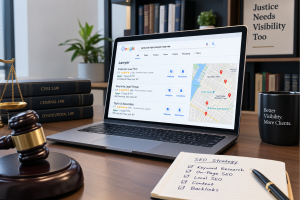
Law firms often hear the terms local SEO and organic SEO used interchangeably. While they are closely related, they focus on different parts of search visibility.
Local SEO is primarily concerned with helping a law firm appear in location-based searches, including Google Maps and the local results that appear for searches such as “personal injury lawyer near me.”
Organic SEO focuses on improving a law firm’s visibility in the traditional unpaid search results.
For a law firm that wants to generate consistent online visibility, understanding the difference between the two can help create a more complete SEO strategy.
The important point is that local SEO and organic SEO don’t necessarily compete with each other. In many cases, they work together.
What Is Local SEO for Law Firms?
Local SEO for law firms is the process of improving a law firm’s visibility when people search for legal services in a particular geographic area.
Examples include:
- personal injury lawyer in Dallas
- divorce attorney near me
- criminal defense lawyer in Phoenix
- family lawyer Chicago
- immigration attorney Houston
Local SEO can involve several areas, including:
- Google Business Profile optimization
- Local Maps visibility
- NAP consistency
- Local citations
- Online reviews
- Location pages
- Local keyword research
- Local backlinks
- Location-specific website content
The goal is to make it easier for people in relevant locations to discover and contact the firm.
What Is Organic SEO for Law Firms?
Organic SEO focuses on improving a law firm’s rankings in the traditional search results.
For example, someone might search:
What happens after a car accident?
Or:
How long does a divorce take?
Or:
What does a criminal defense attorney do?
These searches may lead users to articles, practice-area pages, guides, FAQs, or other resources on a law firm’s website.
Organic SEO typically involves:
- Keyword research
- Technical SEO
- On-page optimization
- Content creation
- Internal linking
- Website architecture
- Link building
- Page experience
- Content quality
- Search intent optimization
Organic SEO can help a law firm reach people at different stages of the decision-making process.
Local SEO vs Organic SEO: The Main Difference
The simplest way to understand the difference is to look at search intent and search results.
| Local SEO | Organic SEO |
|---|---|
| Focuses heavily on geographic intent | Focuses on broader search visibility |
| Google Maps and local results are important | Traditional organic results are the primary focus |
| Often targets city and local service searches | Can target local, national, and informational searches |
| Google Business Profile is important | Website content and technical SEO are central |
| Reviews and citations can support local visibility | Content, internal links, and backlinks are important |
| Strong focus on nearby potential clients | Can reach users well beyond the firm’s immediate area |
These aren’t completely separate SEO systems. A law firm’s website can benefit from both.
How Local SEO Helps Law Firms
Local SEO is particularly relevant for law firms that depend on clients from specific geographic areas.
Consider someone searching:
“car accident lawyer near me”
The search results may include a local map section featuring law firms and other local businesses, along with traditional organic results.
A strong local SEO presence can help the firm compete for relevant local visibility.
Google Business Profile
A properly managed Google Business Profile is an important component of local SEO.
It can display information such as:
- Firm name
- Address
- Phone number
- Website
- Hours
- Reviews
- Services
- Photos
The firm’s business information should accurately represent the actual business.
Read detailed guide on google business profile optimization for law firms & lawyers.
Reviews
Reviews can influence how potential clients perceive a law firm and are also part of the broader local search ecosystem.
Law firms should have a legitimate process for requesting and responding to reviews while following applicable professional and platform rules.
Local Citations
Citations are online mentions of a business’s information, such as its name, address, and phone number.
They can appear on:
- Legal directories
- Local directories
- Bar association websites
- Professional organizations
- Local business websites
Accuracy and consistency are more important than simply creating a large number of listings.
Location Pages
Location pages can help a law firm communicate which geographic areas it serves.
For example:
- Personal Injury Lawyer in Dallas
- Family Lawyer in Austin
- Criminal Defense Attorney in Houston
However, these pages should provide genuine value and accurately represent the firm’s service area.
Creating hundreds of nearly identical city pages simply to target keywords is not a strong approach.
How Organic SEO Helps Law Firms
Organic SEO gives law firms the opportunity to attract visitors through a much broader range of searches.
A potential client may not search for a lawyer immediately.
Instead, they may first search for information about their legal problem.
For example:
Can I sue after a car accident?
A law firm’s educational article could answer that question and introduce the reader to the firm’s services.
Organic SEO can therefore support different stages of the user’s research process.
Service Pages Are Important for Organic SEO
Law firms should have well-structured pages for the services they actually provide.
Examples include:
- Personal Injury Lawyer
- Criminal Defense Lawyer
- Family Lawyer
- Immigration Lawyer
- Divorce Lawyer
- Employment Lawyer
These pages can target searches with stronger commercial intent.
A service page should explain:
- What the service involves
- Types of cases handled
- Who the firm helps
- How the legal process works
- Why someone might need legal representation
- How to contact the firm
The content should be written for prospective clients rather than simply built around keyword repetition.
Informational Content Supports Organic Visibility
Blog posts and legal guides can target questions that potential clients search before contacting an attorney.
Examples include:
- What to Do After a Car Accident
- How Long Does a Divorce Take?
- What Happens During a Criminal Case?
- How Does Child Custody Work?
- What Is a Personal Injury Claim?
These pages can attract users earlier in the research process.
They can then link naturally to relevant service pages when appropriate.
Local SEO and Organic SEO Use Different Signals
Although there is considerable overlap, the two approaches emphasize different areas.
Local SEO commonly involves:
- Google Business Profile
- Local relevance
- Geographic signals
- Reviews
- Citations
- Local links
- Business information
Organic SEO commonly involves:
- Website content
- Search intent
- Technical SEO
- Internal linking
- Backlinks
- Website architecture
- Page experience
There is no single factor that guarantees rankings in either area.
Search visibility depends on many signals and can vary by query, location, competition, and other factors.
Can Local SEO and Organic SEO Work Together?
Yes.
In fact, combining the two can give a law firm’s website a more complete search strategy.
Imagine a personal injury firm operating in Dallas.
The firm’s SEO strategy might include:
Local SEO
- Optimize its Google Business Profile
- Maintain accurate business information
- Build relevant local citations
- Encourage legitimate client reviews
- Create useful Dallas-focused content
Organic SEO
- Build a comprehensive personal injury service page
- Publish helpful accident-related guides
- Improve technical SEO
- Build relevant internal links
- Earn authoritative backlinks
These activities address different search opportunities while supporting the same overall business goal.
Example: Personal Injury Law Firm
Suppose someone searches:
“personal injury lawyer Dallas”
This search has strong local intent.
A law firm’s local SEO efforts may help it appear in local search features, while its website’s organic SEO can help its relevant page appear in traditional search results.
Now consider another user searching:
“how long after a car accident can you sue?”
This is primarily an informational search.
A useful article could attract that visitor through organic search.
The same website could then guide the visitor toward a relevant personal injury service page.
This illustrates why a law firm doesn’t necessarily need to choose between local and organic SEO.
Which Keywords Should Local SEO Target?
Local SEO is especially relevant for searches involving geographic intent.
Examples:
- personal injury lawyer Dallas
- Dallas personal injury attorney
- divorce lawyer Chicago
- family attorney Houston
- criminal defense lawyer Phoenix
- lawyer near me
However, don’t assume every keyword containing a location needs its own page.
Several variations may represent the same search intent and can often be addressed by one strong page.
Read helpful guide on local keyword research for law firms.
Which Keywords Should Organic SEO Target?
Organic SEO can target a much wider range of searches.
Examples include:
- what is personal injury law
- how does divorce work
- what happens after a DUI arrest
- how child custody is determined
- how to file for bankruptcy
- what does an immigration lawyer do
It can also target commercial keywords such as:
- personal injury lawyer
- family lawyer
- criminal defense attorney
The important question is what the searcher is trying to accomplish.
Local SEO Is Not Just Google Maps
One common misconception is that local SEO means only ranking in Google Maps.
Local SEO also involves the law firm’s website and broader online presence.
Important areas can include:
- Website location pages
- Local content
- Citations
- Reviews
- Local backlinks
- Business information
- Location-based keyword research
A law firm’s local presence should be consistent across its website and relevant external platforms.
Organic SEO Is Not Only Blogging
Another misconception is that organic SEO simply means publishing blog posts.
Blog content can be valuable, but organic SEO also includes:
- Technical SEO
- Service pages
- On-page optimization
- Internal linking
- Site architecture
- Page speed
- Structured data
- Backlinks
- Content updates
A law firm’s core service pages can be just as important as its educational content.
Which One Should a Law Firm Focus On?
There isn’t one universal answer.
It depends on the firm’s:
- Business model
- Practice areas
- Service area
- Competition
- Existing online visibility
- Geographic market
- Business goals
A firm that depends heavily on clients from a specific city may place significant emphasis on local SEO.
A firm serving clients across a broader geographic area may also place substantial emphasis on organic search.
Many firms can benefit from combining both.
Rather than treating local SEO and organic SEO as competing strategies, consider them two parts of the firm’s overall search marketing approach.
How to Build a Combined SEO Strategy
A practical strategy could look like this.
1. Build Strong Service Pages
Create comprehensive pages for the firm’s main practice areas.
2. Optimize the Local Presence
Make sure the firm’s Google Business Profile and other business information are accurate.
3. Research Local Keywords
Identify important combinations of legal services and locations.
4. Create Useful Location Pages
Build location pages only where they serve a genuine business and user need.
5. Publish Educational Content
Answer common questions potential clients have about the firm’s practice areas.
6. Strengthen Internal Linking
Connect relevant articles, service pages, and location pages.
7. Build Relevant Authority
Earn legitimate links and mentions from relevant legal, professional, local, and authoritative websites.
8. Monitor Performance
Use search and website data to identify which pages and queries are generating visibility and engagement.
Common Mistakes to Avoid
Focusing Only on Maps
A law firm’s website can miss valuable organic opportunities if the entire SEO strategy revolves around Google Maps.
Focusing Only on Blog Traffic
Traffic from informational searches doesn’t automatically translate into clients. Commercial service pages and conversion paths matter too.
Creating Hundreds of Location Pages
Location pages should exist for a real reason and contain useful information.
Ignoring Technical SEO
Even excellent content can struggle if a website has significant technical problems.
Keyword Stuffing
Natural language is more useful than repeating the same legal and location keywords throughout a page.
Separating Local and Organic SEO Completely
The two strategies often support each other. For example, a strong website can support both local visibility and traditional organic search.
Local SEO vs Organic SEO: A Simple Way to Think About It
Think of local SEO as helping answer:
“Which relevant law firms can help me in my area?”
Organic SEO often answers:
“Which website can best answer my legal question or provide the service I’m searching for?”
In reality, the two can overlap significantly.
A law firm can appear in local search results while also ranking organically with its website.
Final Thoughts
Local SEO and organic SEO serve different purposes, but law firms often benefit from using both as part of a broader search strategy.
Local SEO helps build visibility around geographic intent, local services, Google Maps, business information, reviews, and other local signals.
Organic SEO helps a law firm’s website compete for service-related, informational, and other relevant searches through content, technical optimization, internal linking, backlinks, and website structure.
The right approach depends on the firm’s services, locations, competition, and goals.
Instead of choosing one approach exclusively, build a website that serves both types of searchers: people actively looking for a lawyer in a particular area and people who are still researching a legal problem.
That combination can create a stronger and more useful search presence for a law firm over the long term.